


How to design inclusive commercial washrooms
- Insights
- Commercial
Commercial washroom design has always had to balance privacy, safety, accessibility and practicality. Recent reporting on new guidance from the Equality and Human Rights Commission has brought single-sex and gender-neutral facilities back into public focus.
In May 2026, the updated EHRC draft Code of Practice was laid before Parliament, moving it one step closer to coming into force. It follows the Supreme Court ruling on the meaning of sex in the Equality Act 2010 and confirms that single-sex facilities should be provided on the basis of biological sex. It also makes clear that suitable alternative provision, such as self-contained gender-neutral or universal toilets, should be considered so that nobody is left without access to appropriate washroom provision.
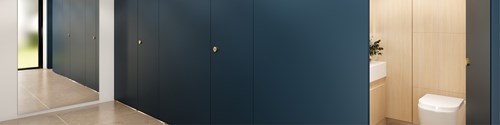
Every building is different. A restaurant, office, hospital, leisure centre, school or shopping centre will all have different users, pressures and space constraints. But in every case, washroom design needs to be considered early. The right layout can make the whole space work better for everyone.
The latest EHRC draft Code covers services, public functions and associations. In practice, this is relevant to many public-facing environments, including hospitality, leisure, retail, healthcare and transport settings such as airports.
Offices and schools are slightly different, because staff facilities and education provision sit under other parts of equality law. Even so, the aim is the same. Washrooms still need to feel private, practical and easy to use.
It is not as simple as adding another toilet cubicle, especially where space is tight. The whole washroom needs to be planned properly, taking into account cubicle type and handwashing provision, sightlines, signage, access and circulation.
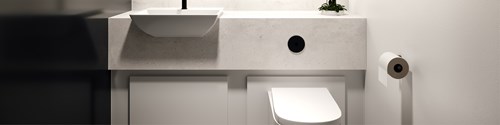
Approved Document T came into effect in England in October 2024. It gives Building Regulations guidance for toilet accommodation in buildings other than dwellings.
For buildings other than dwellings, Approved Document T says toilet accommodation should include either:
Importantly, it is possible to use universal toilets alongside single-sex washrooms to give users more choice, privacy and flexibility.
A universal toilet is a fully enclosed, self-contained toilet for individual use by people of either sex. It includes a WC, washbasin and hand-drying facilities within the same lockable space.
A universal toilet gives each user their own private space from start to finish. That can make a big difference in busy commercial environments, especially where the building is used by many different people throughout the day.
Often referred to commercially as a superloo, Venesta’s MyPod system is designed to create a private, self-contained washroom space.
The EHRC guidance refers to gender-neutral toilets or changing rooms having self-contained, lockable areas with floor-to-ceiling walls and washbasins.
Self-contained toilets help answer many of the concerns people have around shared washrooms. There is no communal handwashing area. There are no gaps around the cubicle where privacy may feel compromised. Instead, each user has one clear, private space.
This can be helpful for many different people, including disabled users, older people, parents, carers and anyone who may not feel comfortable using single-sex facilities.
It also makes the layout easier to understand. Good washroom design should feel clear from the moment someone walks in. Users should not have to work out where they are allowed to go or whether a space is suitable for them.
Approved Document T includes different toilet types, and it is worth understanding them before the washroom layout is designed.
Type A: fully enclosed self-contained ambulant universal toilet
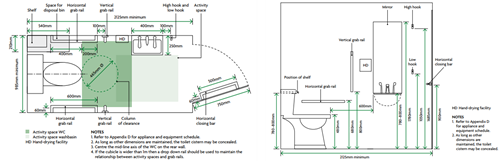
This is a self-contained universal toilet designed for ambulant disabled users. It includes the WC, washbasin and hand-drying facilities within the same space, with support rails and an outward-opening accessible door where required.
Type B: fully enclosed self-contained universal toilet
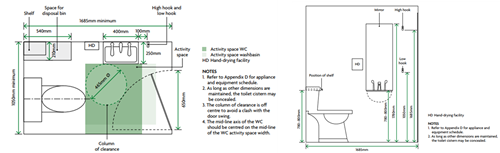
This is a universal toilet for individual use. It includes the WC, washbasin and hand-drying facilities within a fully enclosed room.
For universal toilets, partitions should be floor to ceiling with a full-height door. Direct sightlines from a corridor to the WC and washbasin should also be avoided.
Type C: ambulant single-sex toilet cubicle
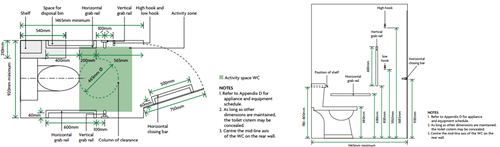
This is an ambulant cubicle within a single-sex washroom. It is not self-contained, so the washbasin and hand-drying facilities are provided in a separate single-sex area.
Type D: single-sex toilet cubicle
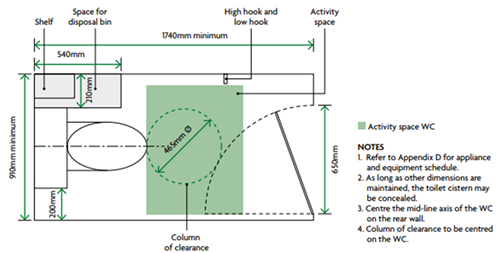
This is a standard single-sex toilet cubicle. Again, handwashing is provided outside the cubicle within the single-sex washroom area.
These details matter because they affect the whole washroom. Door swing, cubicle size, washbasin position, support rails, circulation space and signage all need to work together.
For many commercial buildings, the best solution will be a mix of facilities. That might include:
This gives users more choice without forcing every washroom into one format. For example, a larger commercial building may benefit from single-sex washrooms, full-height cubicles and a small number of fully enclosed universal toilets. A smaller building may not have space for separate male and female washrooms, so universal toilets may be the most practical option.
Refurbishment projects can be more complex. Existing drainage, walls, door positions and circulation routes may limit what is possible. This is why early specification support is so valuable. The sooner washrooms are considered, the easier it is to get the layout right.
Inclusive washroom design can go wrong when it is treated as a late-stage detail.
By the time the cubicles are being specified, the space may already be too fixed to make the best layout work. Common issues include:
Good design avoids these problems by looking at the whole space early on.
We support architects and specifiers with washroom solutions that are practical, durable and designed around the needs of the building.
Our product range includes toilet cubicles, full-height cubicles, MyPod, Vepps IPS panelling and systems, vanity units, washtroughs, Mirror Box Units and accessories.
That means we can help specifiers create washrooms that suit the space, the budget, the building type and the people using it.
We can also support with product selection, layout guidance and technical advice, including Doc T requirements for universal toilets, ambulant toilets and single-sex cubicles.
For projects where privacy, compliance and user choice all need to be balanced, early advice can make the process much smoother.
The latest guidance has brought a complex issue back into focus. But the design principles are the same as they’ve always been. Commercial washrooms need to be private, safe, accessible, easy to use and suitable for the people who need them.
In many cases, the right answer will be a balanced mix of single-sex toilet cubicles, full-height cubicles, accessible provision and fully enclosed universal toilets working together.
As expectations continue to evolve, early washroom planning will become even more important. With the right specification support, inclusive washroom design can feel much more straightforward.
Venesta’s Specification Managers can help you understand the options available, from Doc T toilet layouts and cubicle configurations to privacy, durability and product selection. We can also support your team through CPDs and technical guidance, helping you plan washrooms that work for the building, the brief and the people using them.
For help with inclusive commercial washroom design, Doc T toilet layouts or product specification, get in touch with your local Specification Manager to arrange a call or site visit.
Inclusive washroom design means creating toilet facilities that are safe, private, accessible and suitable for a wide range of users. This may include single-sex toilets, accessible toilets, ambulant cubicles and fully enclosed universal toilets.
A universal toilet is a fully enclosed, self-contained toilet for individual use by people of either sex. It includes a WC, washbasin and hand-drying facilities within the same lockable space.
No. A universal toilet is designed for individual use by people of either sex. An accessible toilet is designed for disabled users, including wheelchair users. Some universal toilets may also include ambulant disabled provision, depending on the layout.
They are closely related, but the terms are used slightly differently. Universal toilet is the term used in Approved Document T. Superloo is the commercial term often used for a self-contained toilet space with a WC, washbasin and hand-drying facilities inside.
Venesta’s MyPod system is designed for this kind of self-contained washroom provision.
Approved Document T says toilet accommodation in buildings other than dwellings should include reasonable provision for male and female single-sex toilets, or universal toilets where space does not allow for single-sex toilets. Universal toilets can also be provided in addition to single-sex toilets.
Floor-to-ceiling cubicles provide a higher level of privacy. In universal toilets, full-height partitions and full-height doors help create a self-contained space for one user at a time. In single-sex washrooms, full-height cubicles can also help improve privacy and user comfort.
The best layout depends on the building. Many commercial spaces benefit from a mixed approach, with single-sex toilets, full-height cubicles, accessible provision and fully enclosed universal toilets.
Yes. Venesta can support architects, specifiers and clients with product selection, layout planning and technical guidance for Doc T toilet requirements.
We can also arrange a CPD at your practice, in our London showroom or by video, helping your team understand the latest guidance and specify washrooms with confidence.


